Pressure testing at NUI
2026-09-03
In June 2026 Thelma Biotel pressure tested transmitters and receivers at NUI in Bergen, thus establishing depth ratings from testing.
Background
Previous depth ratings were based on materials and wall thicknesses. Although a reasonable approach, depth ratings were conservative. This triggered testing in a calibrated pressure chamber for two main reasons.
First, the transmitters on some of the animals and equipment our customers tag must withstand great depths. These are cases where an accurate depth rating matters in practice so customers can confidently deploy our equipment.
Second, a transmitter that fails inside an animal is one we never get back. Thus, if a transmitter failed at depth there was no way to inspect the transmitter or otherwise obtain data on any weak points.
A test was therefore set up in a calibrated pressure chamber to run the equipment past its expected tolerance to get an accurate depth rating.
Test setup and method
In cooperation with NUI, a test was conducted on June 23rd and 24th in the Asterix HTS II pressure chamber containing fresh water at approximately 18 degrees. The pressure chamber was equipped with a calibrated Keller PA-33X reference pressure sensor for logging. Test engineers from NUI's conducted and witnessed the testing, wrote and signed the test report. All equipment in the chamber was filmed.
44 units were tested simultaneously:
- 38 transmitters in 6, 7, 9, 13 and 16 mm sizes, in both ID and pressure sensing configurations
- Two TBR 800
- Two TBR 800 Release
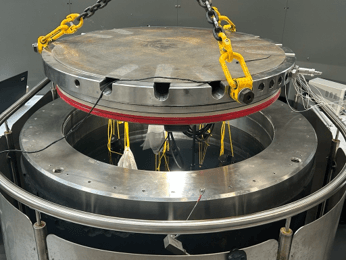
- Two Live units, cabled out through the chamber lid for real time data access during testing (Figure 1 and Figure 2)
The transmitters were suspended in fabric bags, so every unit was subject to the same pressure (i.e., depth) during testing.
Figure 1 – Equipment suspended from pressure test tank lid.
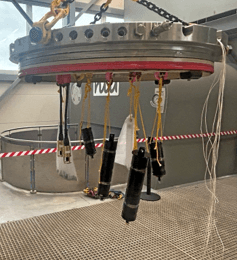
Figure 2 – Equipment being lowered into pressure test tank.
Seven pressure levels, each maintained for one hour:
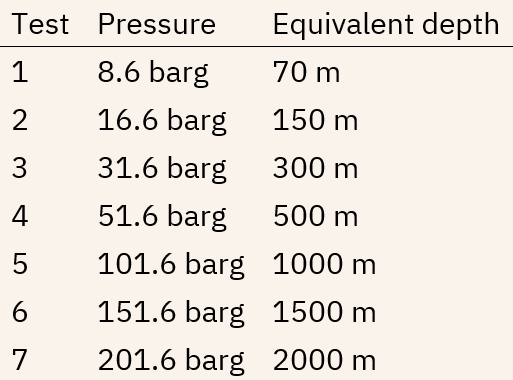
Pressure was released completely between tests to simulate pressure cycles. for repeated pressurization and depressurization.
A unit passed a test level if it transmitted after pressure was released. Physical condition alone was not used as a single criterion, since a unit can be seemingly undamaged and still be nonfunctional. Similarly, a unit can sustain some deformation and still be functional.
The pressure transmitters logged chamber pressure throughout the test, which was referenced against NUI's calibrated pressure sensor. Deviation was within 0.1 bar across the pressure transmitters measurement range. The logged pressure through all seven test levels is available as an interactive chart, viewable test by test, here.
Results / Depth ratings
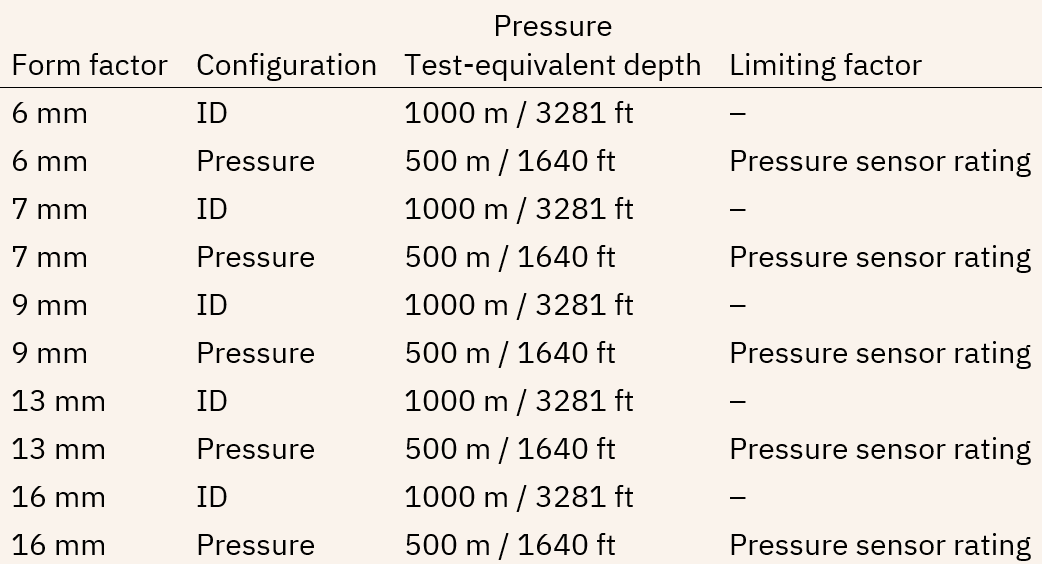
Transmitter units started failing beyond a test-equivalent depth of 1000 m. Observed physical damage clustered around the joint between the piezo element and the battery visible as chipping and cracking. Some units showed compression damage along the longitudinal axis at the middle. Because all transmitters worked down to a test-equivalent depth of 1000 m, this became the rating for transmitters without pressure sensor. For transmitters with pressure sensor, the sensor itself has a pressure tolerance of 500 m which, thus, dictates the pressure rating even though the housing itself withstood higher pressures.
The Live units withstood far greater test pressures than expected as their limiting factor is a cable gland / strain relief pressure rated to 5 barg (50 m / 164 ft). Despite this limitation, the first unit was removed from the chamber after the 300 m test level, while the second remained connected but began to give noisy data below 500 metres, returned to normal at 1000 metres, then stopped working altogether at 1500 metres. It is worth noting that the live unit cannot be practically operated using cables longer than 50 m. Exposing these units to pressures with an equivalent depth below 50 m was mainly to obtain as much real-time data as possible during the pressure test.
Both TBR 800 receiver units were working at a pressure test-equivalent depth of 2000 m / 6562 ft. Subsequent inspection however, revealed internal mechanical damage. Thus, the depth rating was set to 1000 m / 3281 ft.
In summary, pressure test-equivalent depths for the equipment tested were (duplicated from NUI’s test report):
Transmitters
Receivers
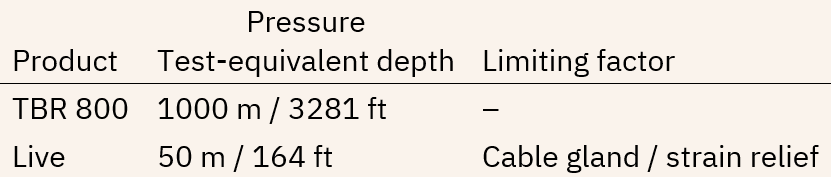
TBR 800 Release is not included in these results as the release functionality could not be reliably tested using the pressure tank set up. TBR 800 release receiver functionality matched that of the TBR800, but the release motor was not run under relevant pressure due to the limitations of the Live unis transmitting the release signal.
Because the release function is the purpose of the product, this test did not give information about the depth at whichit can be relied. This therefore requires a separate test with dedicated firmware timing the release which is the next pressure testing step for this product.
Summary
The depth ratings on our datasheets are now based on a documented test carried out by an independent 3rd party. The full test report, including chamber pressure curves for all seven test levels and the calibration certificate for the reference sensor, is available for download: Pressure test report (NUI Bergen, 2026).
Questions about your own deployment? Get in touch.